
Japanese
Hiromichi Kamata

Research Profile

Hiromichi Kamata

Researcher and engineer at Sony Group Corporation, working on AI and 3D technology R&D. I collaborate with teams across Japan and abroad, with publications accepted at top-tier venues including CVPR and AAAI. Since 2025, I also serve as a board member of the Japan Committee for the International Olympiad in AI (JOAI).

Affiliations

Experience

AI / 3D Technology R&D, Project Leader 2022 – Present

Sony Group Corporation

Working on applied R&D at the intersection of 3D technology and video production. Collaborating with teams across multiple countries on shared research projects, with papers accepted at top venues including CVPR and AAAI.

Research Project Management 3DGS Generative Models CVPR / AAAI
Board Member 2025 – Present

Japan Committee for the International Olympiad in AI (JOAI)

Involved from the founding of the organization, working on domestic competition operations, sending Team Japan to the international event, and running AI outreach programs for middle and high school students. Also collaborating with MEXT and METI to help build a broader ecosystem supporting young AI learners in Japan.

Operations Sponsorship Government Relations Outreach

Research Interests

Career

  1. 2016 - 2020 B.E., Department of Mechano-Informatics, The University of Tokyo
  2. 2020 - 2022 M.S., Department of Mechano-Informatics, Graduate School of Information Science and Technology, The University of Tokyo, Harada Lab
  3. 2022 - Present Sony Group Corporation
  4. 2025 Establishment of Japan Committee for the International Olympiad in AI
  5. 2025 - Present Board Member, Japan Committee for the International Olympiad in AI

Events

Publications

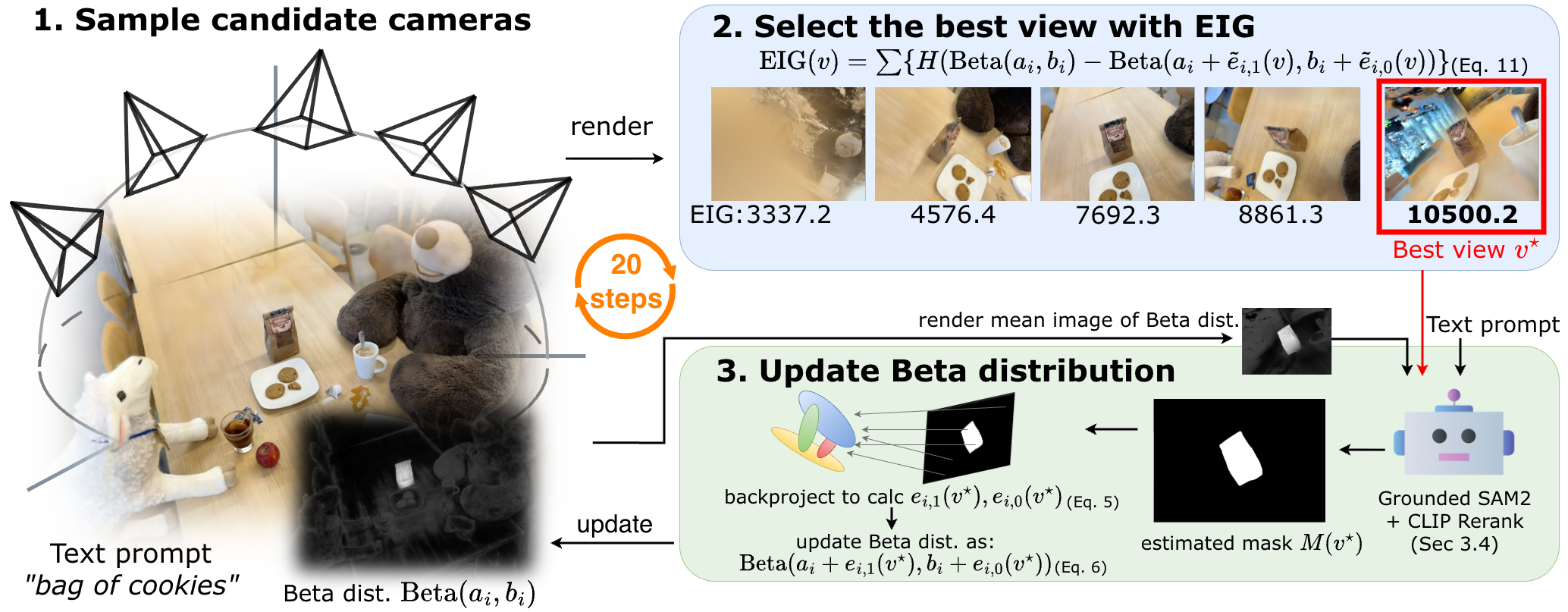
B^3-Seg overview

B^3-Seg: Camera-Free, Training-Free 3DGS Segmentation via Analytic EIG and Beta-Bernoulli Bayesian Updates (CVPR 2026)

Hiromichi Kamata, Samuel Arthur Munro, Fuminori Homma

B^3-Seg is a segmentation method for 3D Gaussian Splatting scene representations that balances boundary quality and training efficiency. By combining coarse region-level alignment with progressive boundary refinement, it produces stable, high-quality masks even in complex scenes while keeping practical compute costs. This work was accepted to CVPR 2026.
Instruct 3D-to-3D overview

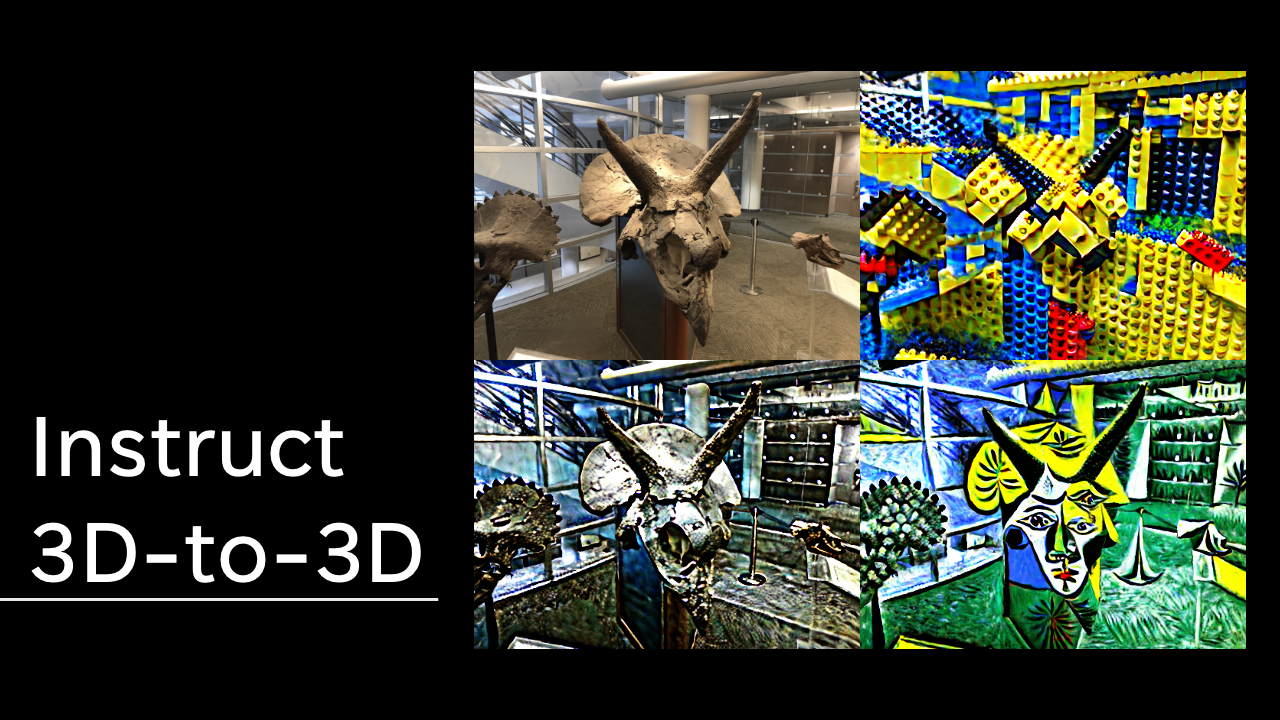
Instruct 3D-to-3D (MIRU 2023)

Hiromichi Kamata, Yuiko Sakuma, Akio Hayakawa, Masato Ishii, Takuya Narihira

This method targets text-guided 3D-to-3D editing, transforming an input 3D scene into a new one according to natural-language instructions. It leverages a pretrained image-to-image diffusion model for per-view optimization while conditioning explicitly on the original 3D scene, improving 3D consistency and structural preservation. It also introduces dynamic scaling to control the strength of geometric deformation.

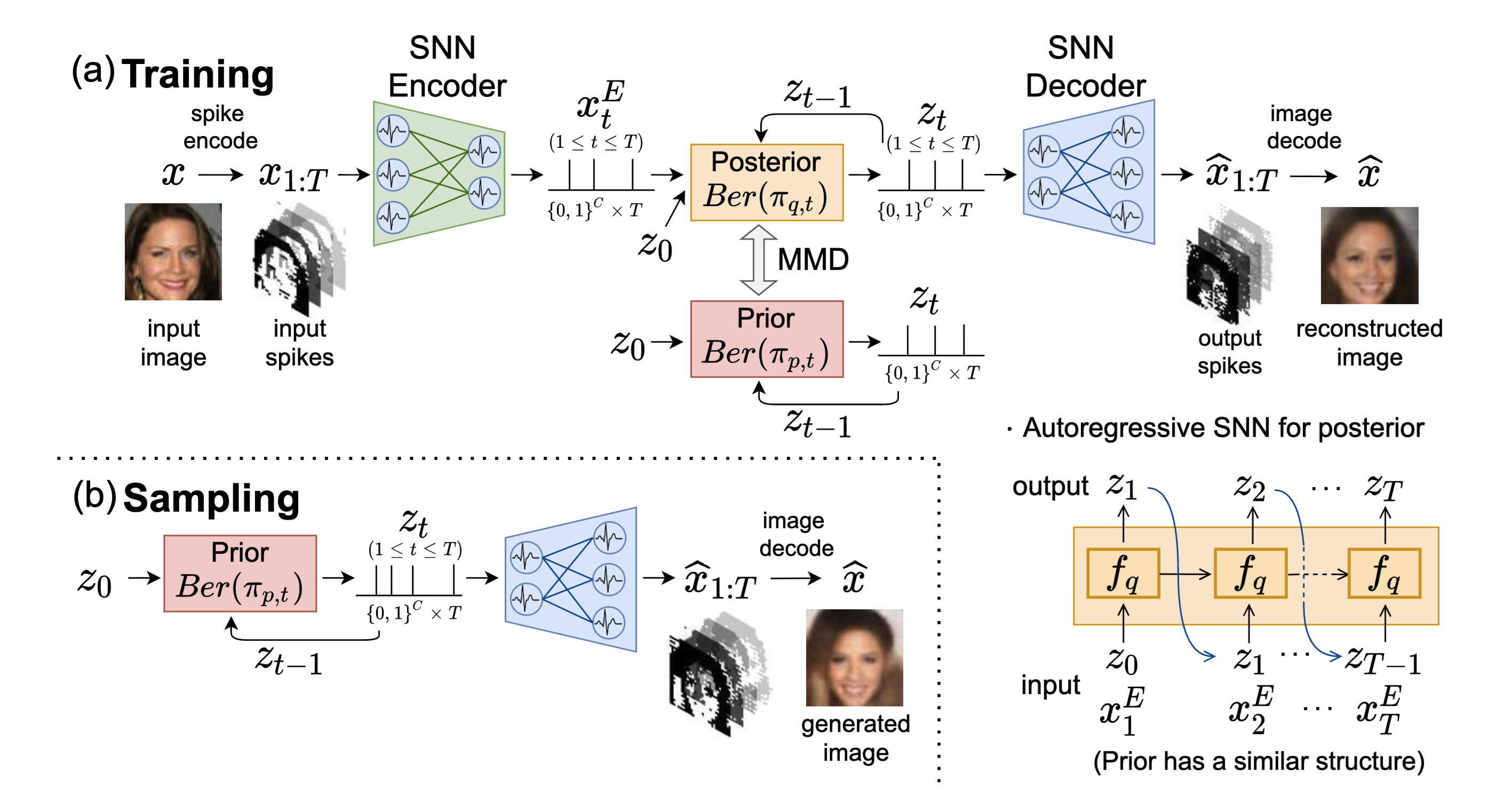
Fully Spiking Variational Autoencoder overview

Fully Spiking Variational Autoencoder (AAAI 2022)

Hiromichi Kamata, Yusuke Mukuta, Tatsuya Harada

This work proposes a VAE built entirely with spiking neural networks (SNNs). To address the mismatch between conventional continuous latent sampling and spike-based computation, it introduces an autoregressive SNN design that models latent variables as Bernoulli processes, enabling variational learning on SNNs. Results on multiple datasets show generation quality comparable to or better than ANN-based baselines.

News

Links